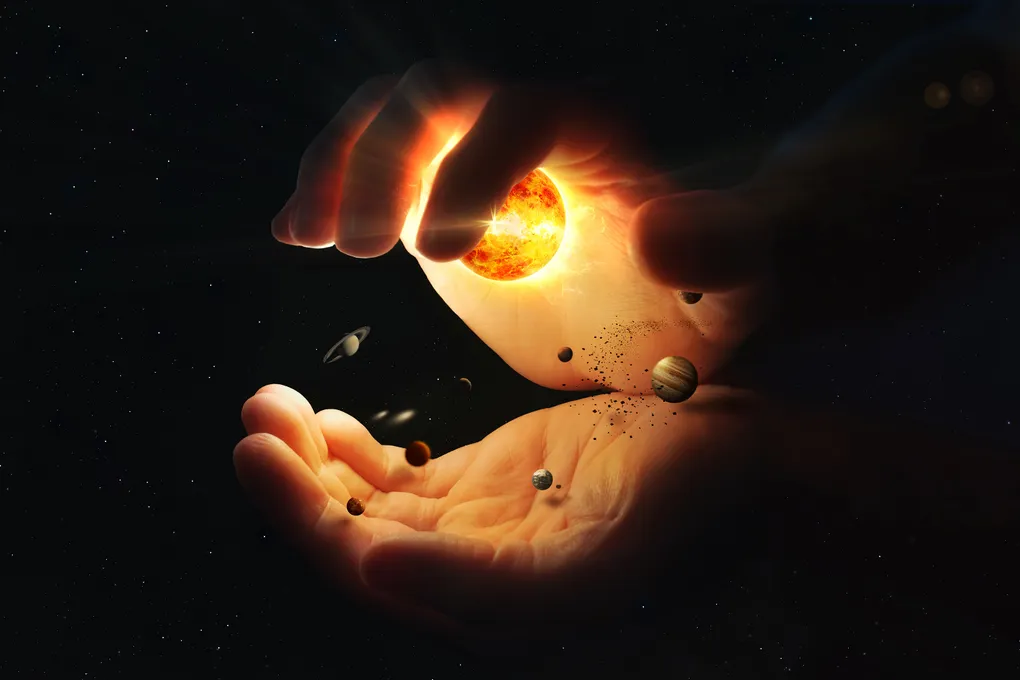
Fate Frequency: From Catholic to Atheist, Back to Christian, and Into the Mystery of Co‑creation With Astrology and Quantum Physics
I grew up Catholic. First Communion, confirmation, youth groups, “everything is written in the book,” and plenty of guilt to keep it all feeling real. For a long time, my faith felt like a clear set of rules, and God felt like a distant but all‑seeing referee. I memorized catechism answers, prayed before meals, and somehow believed that everything was already decided—that predestination was the air I was breathing.
Then came college.
Somewhere between late‑night philosophy conversations and the overwhelming sense that life’s script didn’t match the Sunday‑school version, I became an atheist. It wasn’t dramatic, more like a slow unraveling. I didn’t hate God; I just stopped believing in the shape I’d been given. If everything was already written, then what was the point of asking questions, fighting for anything, or feeling responsible for my choices?
For a while, I lived almost entirely in the free‑will camp. I told myself: You are the author. You build the life. No one’s watching. That felt empowering—but also lonely. It was hard to explain why certain patterns kept repeating, why timing sometimes felt uncanny, or why doors opened and closed in ways I couldn’t control, no matter how hard I tried.
Then, God went fishing for me.
I’m not talking in a metaphorical “I had a realization” kind of way. I’m talking about something that felt like a deliberate, outside‑of‑me intervention. It started small: a book I didn’t plan to read, a conversation I didn’t plan to have, a sense—over months—that I was being led toward a truth that wasn’t just my own invention. Slowly, I began to soften back toward God, not as a distant judge, but as a presence who was somehow both beyond and within everything.
I became a Christian again, but not the same one I had been. I wasn’t satisfied with either “God wrote it all” or “you create it all.” The tension between predestination and free will kept gnawing at me. If God knew the beginning and the end, did I really have a say? If I made every choice, did that mean God was just a cosmic observer? Neither answer felt fully true.
Over time, I landed somewhere in‑between.
I started to see life as a rhythm: there are seasons that feel like they’re already in motion—job markets, family cycles, planetary transits, global moods, even the “cosmic weather.” Certain decisions are limited by the context you’re in: the era you’re born into, the body you have, the people around you, the planets shifting overhead. That feels like a lot of predestination—a field already planted, a storm already forming.
But within that, I realized there’s also a lot of free will. The plant doesn’t choose the soil, but it can choose how it grows toward the light. A storm is coming, but you can decide what you pack, where you take shelter, and how you move through it. So much of life feels like dancing inside a pattern that’s already in motion.
That’s when astrology began to make sense—not as a fortune‑telling system, but as a language for the patterns themselves. The birth chart, transits, and progressions felt like a way to read the “cosmic weather” of your life. And Fate Frequency is my way of exploring that more deeply: what role God plays in the background, and what part we’re meant to play in the co‑creation.
If the Bible is the foundation, the question is: How does God actually work?
How does He communicate?
How does creation unfold?
And how do we co‑create our lives with Him, rather than simply obeying a fixed script or pretending we’re building everything from scratch?
I started wondering if the language that underpins all of this is something like Quantum Physics—the idea that reality exists as a field of potentials until something causes a “collapse” into a specific outcome. What if life is a series of quantum decisions, where our attention, choices, and prayers are somehow the “measurements” that collapse the wave function?
In that view:
Predestination is the field of potentials laid out by God.
Free will is the way we, in relationship with Him, keep choosing where to focus, what to say yes or no to, and what to call into form.
Astrology is a symbolic map of the patterns in that field—like a cosmic probability chart for different seasons of your life.
So Fate Frequency is my attempt to sit in the middle of that tension. I’m not here to settle the debate between “all‑predestination” and “all‑free‑will,” but to explore what it looks like to live inside both truths at once. To read the stars, listen to the Bible, and also pay attention to your own intuition, relationships, and choices as part of a single, unfolding story.
If you’re a Christian who feels uneasy about astrology, that’s okay. Many of the people who feel the most called by Fate Frequency are the ones who grew up with church language but now feel like the old answers don’t quite fit anymore. If you’re a spiritual seeker who’s tired of vague “vibes and manifestations,” this is a space to ask harder questions: not just what is happening, but how it’s happening, and who you are in the middle of it.
Welcome to Fate Frequency, where we’re asking:
How does God create?
How do we co‑create with Him?
And what language—whether it’s scripture, the stars, or quantum fields—can help us navigate the dance between destiny and free will?