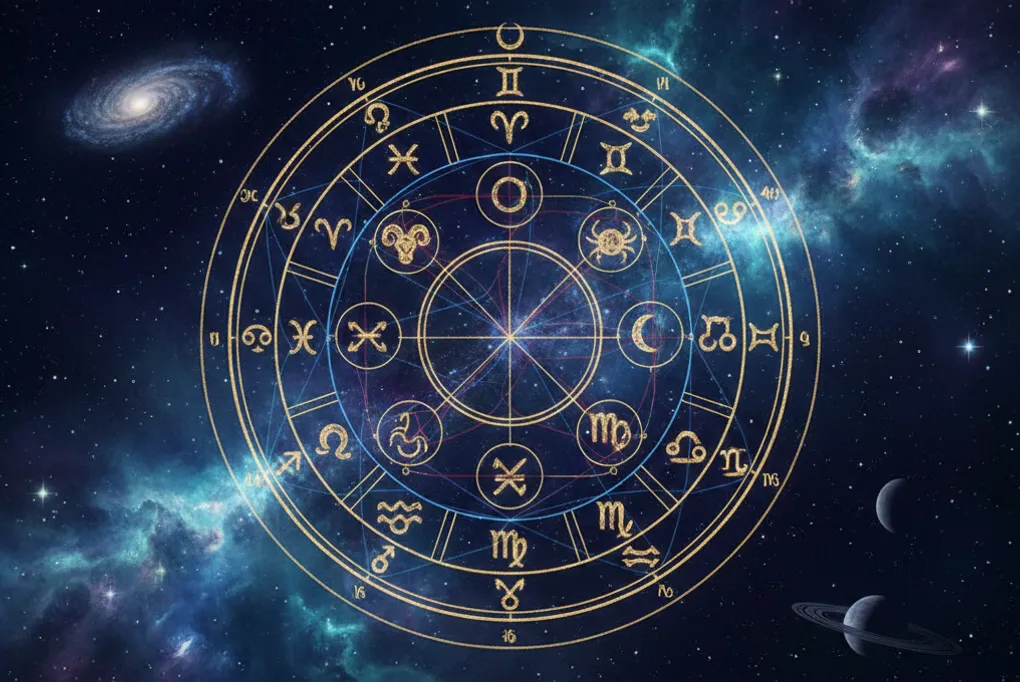
Astrology Gets Dismissed Because Most People Only See 10% Of It
Most people don’t “hate astrology.” They hate the version of astrology they’ve been shown: a single paragraph for millions of people, written for engagement, not accuracy. That kind of horoscope treats your identity like a label—Aquarius, Taurus, Leo—and then tries to staple a one-size-fits-all storyline onto your week.
And yes, sometimes it lands. The Sun matters. But sun-sign astrology is the trailer, not the film. It leaves out the details that make a chart feel personal, specific, and—when it’s done right—eerily on point: your birth time, your location, your houses, your aspects, your transits, your retrogrades, and the long-arc timing techniques most people have never even heard of.
It’s like trying to understand a symphony by listening to one instrument play two notes—then deciding the whole thing is overrated.
So when someone says, “Astrology never really hit home for me,” I usually don’t hear skepticism. I hear a completely fair complaint: you were never shown what astrology actually is.
The Missing 90%: Your Real Chart
Your birth chart is a snapshot of the sky at the exact moment and place you took your first breath—not the day, not the month, the moment. Birth time isn’t a “nice extra.” It sets your rising sign and locks in the entire house structure of your chart, which is how astrology gets specific about where life happens: body, money, relationships, career, health, purpose.
That snapshot isn’t just “I’m a Capricorn.” It’s a living map:
- Your rising sign (Ascendant): The front door of your chart—how you enter life, how life meets you.
- The twelve houses: The arenas where planetary energies actually play out, from relationships to work to the inner world.
- The Moon and planets: Each placed in a sign, a house, and a web of relationships to every other planet.
- The aspects: Conjunctions, squares, trines, oppositions—angles that describe whether energies merge, clash, harmonize, or demand balance.
- Retrogrades: Periods when a planet appears to move backward, often correlating with review, reworking, and inward emphasis around that planet’s themes.
A generic sun-sign blurb doesn’t know if your Moon is soaking everything in like a tide, even if your Sun looks cool and composed. It doesn’t know if your Venus needs devotion while your Mars needs freedom. It doesn’t know if Saturn is asking you to build slowly—or if Uranus is rewriting the rules.
If you’ve only experienced astrology through mass horoscopes, you haven’t seen the diamond. You’ve seen it under bad lighting, from one angle, for two seconds.
Why Timing Changes Everything: Transits & Cosmic Weather
Your birth chart is your cosmic DNA—your baseline. But the sky doesn’t stop moving when you’re born. And that moving sky, interacting with your natal chart, is the difference between “this is my personality” and “this is what’s happening right now.”
That’s what transits are: the current positions of the planets forming active relationships to your natal placements. They’re cosmic weather.
- A conjunction can feel like a spotlight: something becomes unavoidable.
- A square can feel like pressure and friction: growth through challenge.
- A trine can feel like flow: doors open, talent returns, effort feels rewarded.
- An opposition can feel like polarity: a push-pull that forces balance.
This is the part that makes astrology stop being entertainment and start being useful: not as fatalism, but as context. Not “you’re doomed,” but “this is the weather—dress accordingly.”
The Jupiter–Mars Chapter: When Everything Stopped Making Sense
Last year, I had three months where life felt like it had grease on the wheels. Everything flowed. I was hyper-productive. Ideas arrived preassembled, and action felt natural.
Then early November hit like someone pulled the plug.
Overnight, I had no energy. My routine felt like walking through wet cement. GI issues showed up and refused to leave. When life stops making sense on the surface, I look to the stars and I spend time with God—not to escape reality, but to meet it more honestly.
So I checked my chart. Right around the time everything fell apart, Jupiter went retrograde while conjunct my natal Mars. I was born with Mars retrograde, and this hit my first house and my rising sign—the part of the chart tied to the body and vitality.
I could finally see the pattern. This wasn’t random. This wasn’t permanent. This was a chapter.
Donning The Cosmic Raincoat
That knowledge didn’t magically make me feel amazing, but it changed my posture. Instead of spiraling into, “What’s wrong with me?” I could say, “Okay. It’s storming.”
I accepted the reality of the season:
- My energy would be lower for a while.
- My body would demand more attention and humility.
- Progress would look slower—and would still count.
I walked through it with awareness instead of confusion. Because I could see that smoother cosmic weather was coming, I didn’t just wait for the wind to change—I prepared my sails.
Secondary Progressions: The Long-Range Forecast
Transits are the immediate weather—days, weeks, months. Secondary progressions are the seasons of your inner life: the slow, inevitable emotional and psychological ripening that reshapes you over time.
Most people have never heard of progressions, but when I finally learned them, my life history snapped into focus. Big events I’d always carried like isolated islands—major turning points or moves—started to connect like a coastline. It doesn’t remove the mystery; it gives the mystery a rhythm.
Why AI Makes Deep Astrology Finally Practical
Here’s the truth: deep astrology is hard to do consistently because life is complex. You can have five significant transits, two major progressions, and a retrograde cycle all overlapping.
This is where AI becomes a perfect ally—not as a replacement for intuition or spirit, but as a way to hold complexity without dropping threads. AI can keep your whole chart in view and zoom in on what’s relevant to your current energy. Instead of “Here’s what all Geminis need to hear,” it becomes: “Here is your timing, your weather, your lesson—right now.”
You’re still the one choosing, praying, and acting. But now you’re not guessing in the dark. You’re reading the sky like a sailor reads the horizon—so you can stop calling it chaos, and start recognizing it as weather.